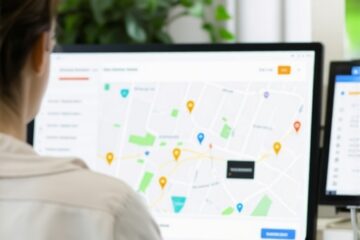
The Backlink Mistake That Keeps Your Map Pin From Moving
I. The “Invisible Ceiling” in the Map Pack
You’ve done the work. You’ve optimized your Google Business Profile (GBP) until the “strength” meter is a solid green circle. You’ve uploaded high-resolution photos of your team, responded to every single review – even the ones from that guy who complained about the parking – and you’re consistently posting updates. Yet, when you pull up a search grid, your map pin is stuck. You’re sitting at #7, #9, or worse, buried on the second page of the local finder.
It feels like there’s an invisible ceiling. You see competitors with fewer reviews and messier profiles outranking you, and it’s infuriating. This is the “stuck pin” phenomenon, and in my experience as a GBP Product Expert, the culprit is almost always hidden in your backlink profile. You’re likely building links, but you’re building them for a version of the internet that doesn’t exist for local businesses.
Google’s local algorithm relies on three core pillars: Proximity, Relevance, and Prominence. While proximity is largely out of your control (you are where you are), and relevance is handled by your on-page content and categories, “Prominence” is where most businesses fail. Prominence is Google’s way of asking, “How much does the local community and the broader web trust this business?” If your link strategy is flawed, your prominence score stays flat, and your pin never moves. This is often why your ranking reports look great while your shop stays empty.
III. The Technical Killers: Broken Links and Redirect Chains
Beyond the source of your links, the technical integrity of those links is often what’s sabotaging your rank google business profile efforts. Recent research from Rio SEO has highlighted a startling reality: technical debt is the silent killer of local rankings. Specifically, “Broken links (404s, 403s)” and “Improper or excessive redirects (302s)” are the top two technical factors that tank GBP health.
Think of link equity like water flowing through a pipe. Every time a link hits a 404 page, the pipe is capped, and the “prominence” signal is lost entirely. Even worse are redirect chains. If your GBP “Website” field points to an old HTTP version of your site that redirects to HTTPS, which then redirects to a trailing slash version, you are bleeding authority at every jump. Google’s crawlers are efficient, but they are also impatient. If the path to your landing page is convoluted, the algorithm devalues the link’s impact on your map prominence.
This is why it’s critical to how to wipe out the messy citation errors that are quietly tanking your local authority. Your NAP (Name, Address, Phone) data must be mirrored by a clean, direct link structure. If you’re using local seo tools to monitor your backlinks, pay close attention to the “Status Code” of your most valuable local links. A single 302 (temporary) redirect on a high-value local citation can be the difference between the Top 3 and the Top 10.
IV. The Landing Page Mismatch
Another common backlink mistake is the “Homepage Obsession.” Most businesses point every single backlink – and their GBP website link – to their homepage. While this builds overall domain authority, it fails to optimize for specific map pins in multi-location or service-area businesses.
If you are a plumber in Austin but your office is in a suburb, linking your Austin-focused GBP to your general homepage makes it harder for Google to associate that profile with Austin-specific searches. Instead, you should be linking to a geo-optimized service page (e.g., `website.com/austin-plumbing`). This creates a direct thematic and geographic link between the map profile and the content on your site.
This “City Page SEO” is a force multiplier for your map pin. When you build local links specifically to these city-level landing pages, you are feeding the algorithm exactly what it wants: a clear connection between a physical location and a specific service. To take this a step further, implementing the schema tweak that puts your business on the map in neighboring towns can help bridge the gap between your physical office and the areas where you actually do business.
V. The 2026 Shift: AI Agents and Predictive Search
As we look toward 2026, the landscape of google business profile seo is shifting from “Search” to “Answer Engines.” We are entering an era of AI Agents and predictive search where Google’s SGE (Search Generative Experience) and autonomous bots are the primary “consumers” of your data before a human ever sees it.
These AI bots crawl local data differently. They aren’t just looking for keywords; they are looking for “Entity Relationships.” If your backlink profile is messy or lacks local context, these agents will struggle to verify your business’s legitimacy. Furthermore, we are seeing a rise in “AI-Agent Masks,” where autonomous systems scrape data, making it look like you have traffic when you actually have bot noise. This can skew your analytics and make it impossible to tell if your SEO is actually working.
To stay ahead, you need to understand why AI bots skip your store: 4 rank tracker fixes for 2026 maps. You must also learn how to reclaim 2026 maps analytics data lost to AI-agent masks. The goal is no longer just “ranking higher on google maps” – it’s about being the definitive “Entity” that AI agents recommend. Using advanced google maps seo tools is the only way to monitor these non-human interactions and ensure your prominence signals are reaching the right algorithms.
VI. Audit Checklist: Moving the Pin in 48 Hours
If your map pin is stuck, don’t panic. You can often see movement within 48 to 72 hours by cleaning up your technical link equity. Use this checklist to audit your profile today:
- Check the GBP Link: Open your Google Business Profile manager. Click on the “Website” link. Does it go directly to an HTTPS page with a 200 OK status? If it redirects, fix it immediately.
- Audit Primary Categories: Research from Awkward Media shows that your primary category carries 75% of the weight. Ensure your primary category matches the “intent” of your most important local backlink.
- Fix 404s on Citations: Use a google business profile audit tool to identify your top 20 citations (Yelp, YellowPages, etc.). Ensure every one of them links to a live, functioning page.
- NAP Consistency: Ensure your Name, Address, and Phone number are identical across the web. Even a “St.” vs “Street” discrepancy can cause a “Prominence Leak” in 2025’s hyper-sensitive algorithm.
According to Backlinko, 8 in 10 US consumers search for local businesses online. If you aren’t in the Top 3 (the “Map Pack”), you effectively don’t exist to 80% of your market. Technical link integrity is the fastest way to bridge that gap.
Conclusion: Stop Building Links, Start Building Integrity
In the world of google business profile seo, quality and integrity will always beat quantity. You don’t need 1,000 links; you need 10 links that Google actually trusts and that point to a technically sound website. As I always say, “Map rankings look great on paper but fail to drive foot traffic if the underlying link integrity is broken.”
Don’t let technical debt kill your lead flow. It’s time to stop guessing and start using professional local seo software to monitor your progress and catch these errors before they cost you another month of stagnant growth. Unlock the power of local SEO software for small business growth and finally move that pin to the top.